


by Karl Heinz Türk (1928 – 2001)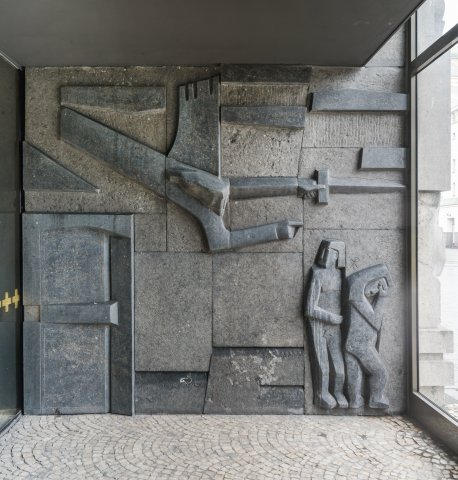
Relief 'The Expulsion from Paradise' by Karl Heinz Türk
Photo: Max Schulz 2019
In a relief made of blue-gray Belgian granite—in the left entrance area, forming a right angle inward next to the image of the main facade—Türk depicts the dramatic final scene of the Old Testament story about the Fall of Man (Genesis 3:22–24) in stone:
Then the Lord God said, “Behold, the man has become like one of us in knowing good and evil. Now, lest he reach out his hand and take also of the tree of life and eat, and live forever—” therefore the Lord God sent him out from the garden of Eden to work the ground from which he was taken. He drove out the man, and at the east of the garden of Eden he placed the cherubim and a flaming sword that turned every way to guard the way to the tree of life. (1. Mose 3, 22-24)
The oversized angel with the flaming sword in his left hand dominates the painting. All movement in the picture moves from the upper left to the lower right and outward. The angel turns the naked and shamed humans away from the door of paradise and denies them access to the tree of life. All figures are rendered with clear contours, de-individualized, and heavily symbolically stylized.
The relief can be seen together with its counterpart in the right entrance area, The Sacrifice of Abraham, and with the image on the main facade, Moses and the Burning Bush. It represents the punishing God, while the other two represent the merciful God and the revealing God, respectively.
Reference:
Fuchs, Martin [Bearb.]; Türk, Karl. H.: Bildhauer K.H. Türk: Werkbericht, Stuttgart 1988.
