


Artistic glass walls of the main facade, König-Heinrich-Platz
crafted in 1959 by Gérard Lardeur (1931 - 2002),
from his window wall in the Vatican Church, Expo Brussels 1958

Top left: Window walls of the former sacristy (now an office) and the south aisle,
top right of the north aisle;
below: window of the former Chapel of Our Lady (now a group room). Photos: Max Schulz 2019
The darker core of the bottom windows displays subtle elements of Christian and secular symbolism in abstract forms (ship, waves, cross, circle, grid, chessboard…) in black glass, encased in a wide band of irregularly shaped glass elements in shades of yellow.
Upstairs, three multi-colored patterns sharing a similar cross-shaped base appear as figurative hints. The primary colors dominate the window facade: blue-purple, red, and blue-turquoise at the top, complemented by yellow at the bottom, each shaded, invariably structured by lead cames, rectangular metal frames, and dark glass, the whole enclosed in a bright frame.
Lardeur assembled the glass walls in Duisburg using parts of the glass wall from the left side of the Vatican Church in Brussels (see photos). The tent-like church had been built solely for the exhibition. The window walls were presented as a gift by the Vatican to the new Diocese of Essen in December 1958 and then forwarded to Duisburg. The window wall on the left was one of Lardeur's first major commissions—the glass wall on the right had been produced by Georg Meistermann, who was already well known at the time (see below).
A brief note in his list of works suggests that Lardeur himself worked in Duisburg: „1958 Bruxelles, Belgique, Exposition Universelle, Pavillon du Vatican/1959 Duisbourg, Allemagne, Cathédrale“.
The architecture of the new building in Duisburg necessitated a major redesign of the Brussels glass wall (see below). This can be clearly seen in the three windows on the upper floor.
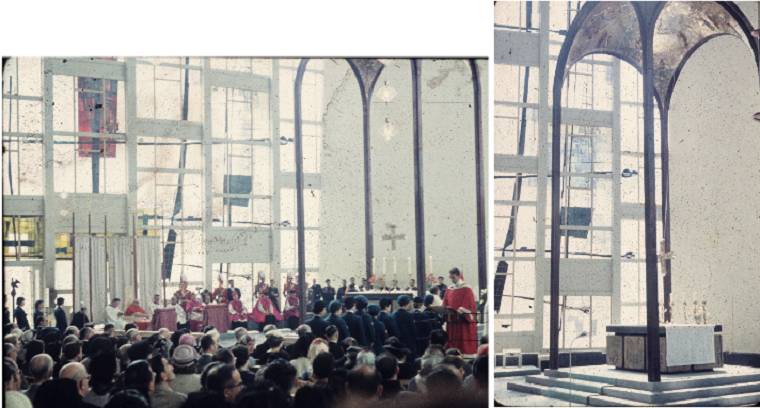
Window wall of the Vatican Church, Gospel side.
Photos: Willems private collection, Ghent University Archives
In the basement, motifs from the Brussels Window can be found directly reproduced.
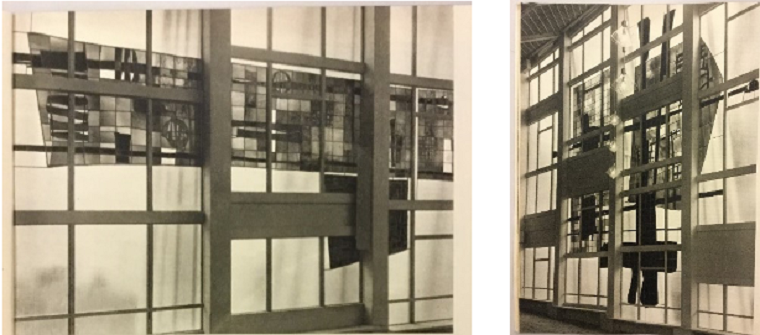
Photo: Details of the Brussels glass wall by Lardeur, from: L’Art église 103, 1958, 45,44
The artist Gérard Lardeur did not produce his first windows for the clerestory of the church of the Dominican convent in Lille until 1957. In addition to numerous sculptures, he created around 100 windows for sacred buildings (including those for the Cathédrale Notre-Dame in Calais). According to De Gruyter’s biographical dictionary of artists, he used an abstract formal language in traditional stained glass, and the interplay with a densely packed network of lead cames was characteristic of his work.

Photo: Website of the Dominican Monastery of Lille, https://dominicainslille.fr (Archive)
References:
N.N.: Lardeur, Gérard, in: De Gruyters Allg. Künstlerlexikon, Bd. 83, 2014, S.199.
https://www.centre-vitrail.org/fr/gerard-lardeur (retrieved March 12, 2023).
https://gerard-lardeur.com/biographie (retrieved March 12, 2023)
Sacristy window of the lower church, Landgerichtsstrasse
Crafted by an unknown artist from parts of the window wall of the Vatican Pavilion at the Brussels World’s Fair (Expo 58), by Georg Meistermann, Cologne (1911 – 1990)"
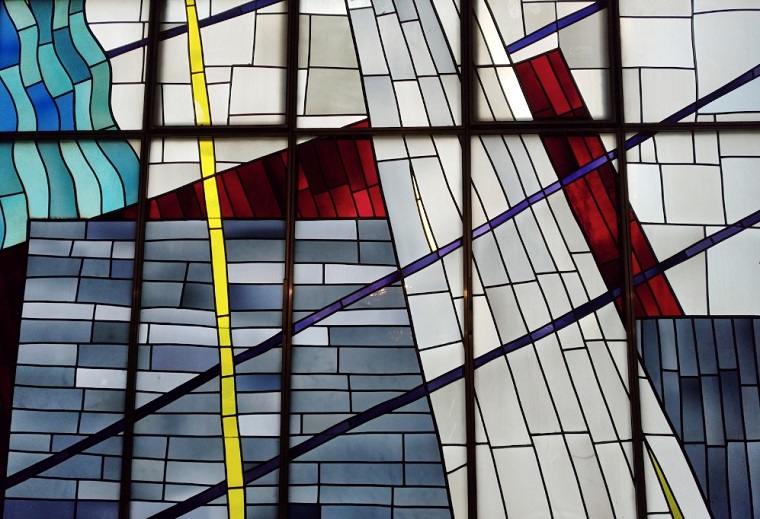
Window of the former sacristy of the chapel in the lower church, photo KB
Wall-like glass elements in graduated shades of gray are intersected by diagonal strips of glass panels in shades of gray and blue and a thin yellow line, which fan out toward the chapel and its altar. The red fields evoke the upper edges of buildings.
This window can be recognized as an adoption of elements from Georg Meistermann's window wall for the Vatican Church at the 1958 Brussels World's Fair (see photo below). It is a redesigned small section from one of the three 'Streams of Grace' (bundled blue rays)—a motif that, alongside the Pentecostal motif of the 'Dove of the Holy Spirit,' defined the visual character of the Brussels window.
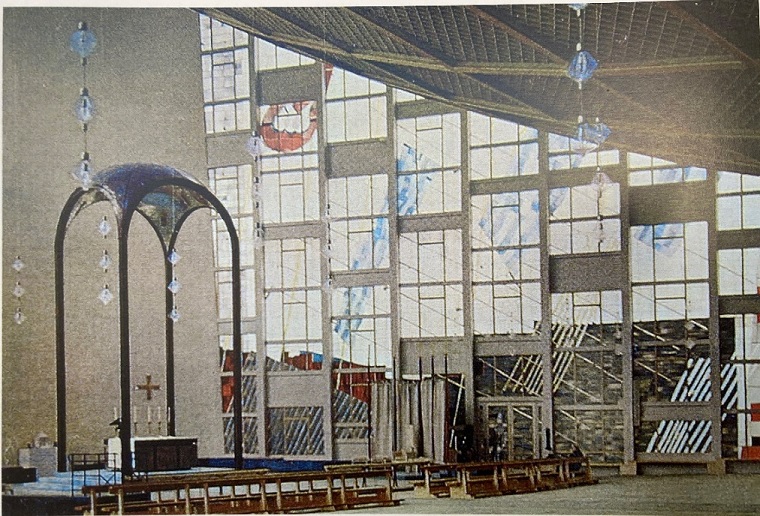
Window wall of the Vatican Cathedral, Epistle side, Georg Meistermann photo postcard 1958,
Heidi Blümer Collection
The ghost dove (top left) was so extensive that there was no suitable place for it anywhere in the Church of Our Lady. One reason for this may be that the leaded glazing originally intended for lighting the nave of Liebfrauen had to be discarded. A structural recalculation had revealed this. And so, the idea of the Plexiglas folded-plate walls was developed in late 1959 and implemented by 1961.
Unused antique glass was usually repurposed. We don't know the specifics.
Georg Meistermann (1911 – 1990) is one of the world's best-known German artists of the recent past. This is primarily due to his more than 1,000 stained glass works, which can be found in numerous Catholic and Protestant churches as well as in secular buildings across Germany and Europe.
About the critical Catholic who was ostracized under National Socialism, his grandson, the art historian Justinus Maria Calleen, writes: He 'created a "mystically animated world of imagery" in his works,' in which 'contouring lines, light colors, and abstract shapes became confessional formulas of a divine certainty of salvation and an unwavering security of faith.“
Meistermann designed the 'Gnadenstrom' (Stream of Grace) motif many times. A well-known version is the 'Gnadenstrom Windows,' which he created for the hospital chapel in Wittlich in 1969.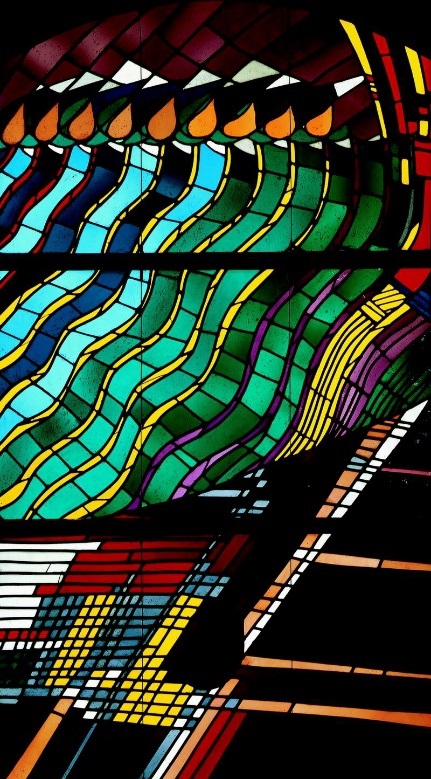 http://www.meistermann-gesellschaft.de/html/georg_meistermann.html
(retrieved March 12, 2023)
References:
Wilhelmus, Liane: Georg Meistermann – Das glasmalerische Werk, Petersberg 2014, S. 340 f.
www.meistermann-gesellschaft.de (retrieved March 12, 2023).
